
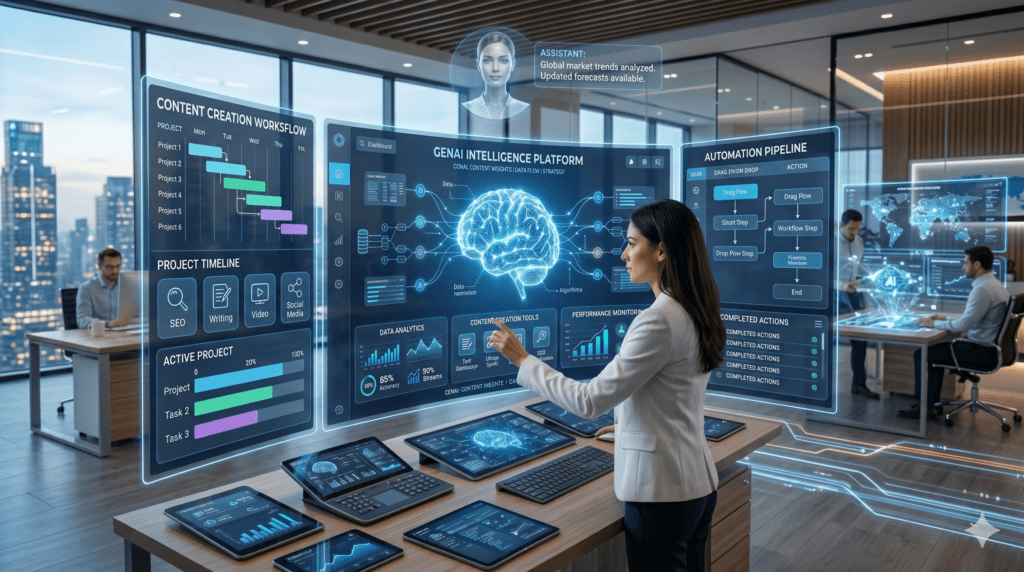
Generative AI technology is helping businesses automate content creation and digital transformation.
Introduction to Generative AI
Artificial intelligence has evolved rapidly over the past decade, but few innovations have attracted as much attention as Generative AI. From writing articles and designing graphics to generating videos and software code, this technology is changing the way people work, learn, and create.
As a digital marketer, I have observed how businesses of all sizes are exploring AI-powered solutions to improve efficiency and reduce operational costs. What once required teams of specialists can now be completed in minutes using intelligent systems.
The growing popularity of AI-driven applications is not simply a trend. It represents a major shift in how technology supports creativity, decision-making, and productivity. Whether you are a business owner, marketer, student, or entrepreneur, understanding Generative AI is becoming increasingly important.
In this guide, I will explain what it is, how it works, where it is being used, and what the future may hold.
What is Generative AI?
Generative AI refers to artificial intelligence systems that can create new content based on patterns learned from large datasets. Unlike traditional software that follows predefined instructions, these systems generate original outputs such as text, images, videos, music, and computer code.
For example:
- Writing blog articles
- Creating social media posts
- Designing marketing graphics
- Generating website code
- Producing AI-generated videos
- Creating customer support responses
The technology relies on advanced machine learning techniques and neural networks capable of understanding context and generating meaningful results.
How Generative AI Works
At its core, Generative AI learns from massive amounts of information. During training, the model analyses patterns, structures, and relationships within data.
When a user enters a prompt, the AI predicts the most relevant output based on its training.
The process generally includes:
- Data Collection
- Model Training
- Pattern Recognition
- Prompt Interpretation
- Content Generation
- Output Refinement
Modern systems can understand natural language, recognize visual elements, and generate highly realistic content that closely resembles human-created work.
Technologies Behind Generative AI
Several technologies contribute to the success of modern AI systems.
Large Language Models
Large Language Models (LLMs) are trained on enormous datasets and can generate human-like text responses.
Examples include:
- ChatGPT
- Claude
- Gemini
Neural Networks
Neural networks mimic how the human brain processes information. They help AI systems identify complex relationships within data.
Deep Learning
Deep learning enables AI models to continuously improve their understanding of language, images, and patterns.
Transformer Architecture
Transformers revolutionised artificial intelligence by allowing models to process context more effectively, leading to significant improvements in content quality.
Key Applications of Generative AI
The impact of Generative AI extends across multiple industries and business functions.
Content Creation
Content marketing requires consistent production of high-quality materials. AI-powered systems help businesses generate:
- Blog posts
- Email campaigns
- Product descriptions
- Social media content
- Video scripts
Many organizations use AI Content Creation tools to accelerate content production while maintaining quality standards.
For businesses interested in improving their online visibility, combining AI-generated content with professional SEO strategies can produce better search engine results. Learn more through our /seo-services page.
Image Generation
AI image generators have transformed graphic design workflows.
Today, businesses can create:
- Advertising creatives
- Website banners
- Product mockups
- Social media graphics
- Marketing visuals
This capability significantly reduces design time and production costs.
Video Creation
Video marketing continues to grow, and AI tools are helping creators produce content faster than ever.
Popular uses include:
- Explainer videos
- Promotional videos
- Training materials
- Social media reels
- Product demonstrations
Businesses that invest in AI-powered video creation can scale content production efficiently.
Software Development
Developers increasingly rely on AI assistants to write, review, and optimize code.
Benefits include:
- Faster development cycles
- Reduced coding errors
- Improved productivity
- Better documentation
AI-powered coding tools are becoming valuable resources for both experienced programmers and beginners.
Customer Support
Customer service teams use AI to provide instant assistance through:
- Chatbots
- Virtual assistants
- Automated ticket management
- Personalized recommendations
This improves customer satisfaction while reducing support costs.
Benefits of Generative AI
Organizations worldwide are adopting AI technologies because of the substantial advantages they offer.
Increased Productivity
One of the most significant benefits is improved efficiency.
Tasks that previously required hours can now be completed within minutes.
Examples include:
- Content drafting
- Data analysis
- Design creation
- Customer support responses
- Marketing campaign planning
Employees can focus on strategic activities while repetitive tasks are automated.
Cost Reduction
Businesses constantly seek ways to optimize resources.
AI contributes by:
- Reducing labour-intensive processes
- Automating routine operations
- Minimising production expenses
- Improving workflow efficiency
Small businesses particularly benefit because they can access capabilities that previously required large teams.
Personalization
Modern consumers expect personalized experiences.
AI systems analyse customer behaviour and preferences to deliver:
- Customized recommendations
- Personalized emails
- Dynamic website experiences
- Targeted advertising
This level of personalization improves engagement and conversion rates.
For businesses seeking stronger online visibility, AI can complement professional digital marketing strategies available through our digital-marketing-services page.
Challenges and Limitations
While AI technology offers remarkable benefits, it is important to understand its limitations. Businesses should approach adoption strategically rather than assuming AI can replace human expertise entirely.
Data Privacy Concerns
AI systems often process large volumes of data. Organizations must ensure that customer information is handled securely and in compliance with privacy regulations.
Common concerns include:
- Unauthorized data access
- Sensitive information exposure
- Data storage risks
- Compliance requirements
Businesses should establish clear policies regarding how AI tools are used and what information employees can share with them.
AI Bias
AI models learn from existing data. If that data contains bias, the system may unintentionally produce biased outputs.
Examples include:
- Unequal recommendations
- Misrepresentation of demographics
- Inaccurate assumptions
- Discriminatory outcomes
Human oversight remains essential to ensure fairness and accuracy.
Accuracy and Hallucinations
One of the biggest challenges of modern AI systems is the possibility of generating incorrect information.
AI can occasionally:
- Invent facts
- Misinterpret context
- Provide outdated information
- Generate inaccurate citations
This is why businesses should always verify important content before publishing or using it for decision-making.
Generative AI for Businesses
Business leaders are increasingly integrating AI into daily operations. The ability to automate tasks and improve efficiency makes it a valuable competitive advantage.
Marketing
Marketing is one of the areas experiencing the greatest transformation.
AI Marketing applications include:
- Content generation
- Audience analysis
- Ad copy creation
- Campaign optimization
- Social media planning
For example, marketers can generate multiple ad variations within minutes, allowing faster testing and better performance.
Companies looking to strengthen their online presence can combine AI-powered workflows with services such as /social-media-marketing and /seo-services.
Sales
Sales teams use AI to improve lead generation and customer engagement.
Benefits include:
- Lead scoring
- Prospect research
- Personalized outreach
- Sales forecasting
- Automated follow-ups
AI helps sales professionals spend more time building relationships and less time performing repetitive administrative tasks.
Customer Service
Customer expectations continue to rise. Businesses must provide fast and reliable support.
AI enhances customer service through:
- 24/7 support availability
- Instant responses
- Reduced wait times
- Multilingual communication
- Automated issue resolution
Organizations can improve customer satisfaction while controlling operational costs.
Automation
Business Automation is one of the most practical applications of AI.
Common automated processes include:
- Appointment scheduling
- Email management
- Data entry
- Report generation
- Workflow management
Automation enables teams to focus on growth-oriented activities rather than repetitive manual tasks.
Businesses investing in modern websites can further improve efficiency through professional /website-development-services integrated with AI-powered features.
Best Generative AI Tools in 2026
The AI ecosystem continues to expand rapidly. Several platforms have established themselves as leaders in innovation and usability.
ChatGPT
ChatGPT remains one of the most popular AI assistants worldwide.
Key strengths include:
- Content writing
- Research assistance
- Coding support
- Business planning
- Customer communication
Its versatility makes it suitable for professionals across industries.
Claude
Claude is widely recognized for producing detailed and thoughtful responses.
Common use cases include:
- Long-form content creation
- Business documentation
- Research analysis
- Strategic planning
Many users appreciate its ability to handle complex discussions and large documents effectively.
Gemini
Gemini combines advanced reasoning capabilities with integration across Google’s ecosystem.
Popular applications include:
- Productivity enhancement
- Search assistance
- Content generation
- Data analysis
Businesses using Google services often find Gemini particularly useful.
Midjourney
Midjourney has become a preferred platform for AI-powered image creation.
Designers use it to generate:
- Advertising creatives
- Concept art
- Website graphics
- Branding visuals
- Product imagery
The quality of generated images continues to improve dramatically.
Canva AI
Canva AI makes design accessible to non-designers.
Useful features include:
- Social media design
- Presentation creation
- Marketing materials
- Image editing
- Content generation
Small businesses benefit from its ease of use and affordability.
Future of Generative AI
The pace of AI development suggests that its influence will continue to expand over the coming years.
The Future of AI will likely involve deeper integration into everyday business operations, education, healthcare, finance, and creative industries.
Organizations that learn to work alongside AI rather than compete against it will gain significant advantages.
Emerging Trends
Several trends are shaping the next phase of AI innovation.
Multimodal AI
Future systems will seamlessly process:
- Text
- Images
- Video
- Audio
- Documents
This will create more natural interactions and broader capabilities.
AI Agents
AI agents are evolving from simple assistants into systems capable of performing complete tasks autonomously.
Examples include:
- Scheduling meetings
- Managing projects
- Conducting research
- Handling customer inquiries
Hyper-Personalization
Businesses will use AI to deliver highly personalized experiences at scale.
Customers can expect:
- Customized recommendations
- Personalized content
- Tailored marketing campaigns
- Enhanced user experiences
Industry-Specific AI Solutions
More specialized AI applications will emerge for industries such as:
- Healthcare
- Real Estate
- Education
- Manufacturing
- Financial Services
These solutions will address unique industry requirements and challenges.
Predictions for the Next 5 Years
Looking ahead, several developments appear likely:
- AI adoption will become standard across businesses.
- Content creation workflows will increasingly rely on AI assistance.
- Customer support automation will become more sophisticated.
- AI-generated video production will grow significantly.
- Small businesses will gain access to enterprise-level capabilities.
- Human-AI collaboration will become the dominant work model.
- Regulatory frameworks will continue evolving to address ethical concerns.
The organizations that invest in AI literacy and responsible implementation today will be best positioned for future success.
Frequently Asked Questions (FAQ)
What is Generative AI?
Generative AI is a type of artificial intelligence capable of creating original content such as text, images, videos, audio, and software code based on patterns learned from large datasets.
How does Generative AI work?
It uses advanced machine learning models and neural networks to analyze information, understand prompts, and generate relevant outputs.
Is Generative AI useful for small businesses?
Yes. Small businesses can use AI for content creation, marketing, customer support, automation, and productivity improvements while reducing operational costs.
Can Generative AI replace human workers?
AI is more likely to augment human capabilities rather than completely replace them. Human creativity, judgment, strategy, and relationship-building remain essential.
What industries benefit most from AI?
Industries including marketing, healthcare, education, software development, finance, customer service, and e-commerce are already benefiting significantly from AI adoption.
Is AI-generated content good for SEO?
AI-generated content can support SEO efforts when it is reviewed, edited, fact-checked, and enhanced with human expertise. Quality and relevance remain critical ranking factors.
Need Help Implementing AI for Your Business?
Generative AI is creating new opportunities for businesses to improve productivity, automate workflows, and enhance customer experiences. However, choosing the right AI tools and strategy can be challenging.
At Digital Suneetha, we help businesses leverage modern technologies, digital marketing strategies, SEO and website development. We specialise in Meta Ads and AI-powered solutions to achieve measurable growth.
Whether you’re looking to improve your online presence, generate more leads, or integrate AI into your business processes, our team can help.
Contact Digital Suneetha today:
📞 Phone/WhatsApp: 9502464852, 7569516794
Let’s discuss how AI and digital marketing can help your business grow in 2026 and beyond.
Conclusion
Artificial intelligence is no longer a futuristic concept. It is actively reshaping how businesses operate, create content, engage customers, and drive growth. Among the many advancements in this field, Generative AI stands out as one of the most transformative technologies of our time.
From AI Content Creation and software development to marketing automation and customer service, the opportunities are immense. Businesses that embrace these tools thoughtfully can improve efficiency, reduce costs, and unlock new levels of innovation.
However, successful adoption requires balance. Organizations must combine the speed and scalability of AI with human expertise, creativity, and ethical oversight. AI should be viewed as a powerful assistant rather than a complete replacement for human decision-making.
As technology continues to evolve, staying informed and adaptable will be essential. Whether you are a business owner, marketer, entrepreneur, or student, understanding Generative AI today will help you prepare for the opportunities of tomorrow.